
Artifacts of Abandonment
Processing BACKROOMS as boundary object.


When is a blockbuster film not a film? When it's a one hour and 45 minute mood.
BACKROOMS — A24's wide release adaptation of the Internet's most persistent liminal space mythology — resists review the way a student design crit resists review. Someone has completed a creative assignment. You have to sit with it. The execution is competent, occasionally striking, impressive in some ways for a 20-year-old (though also backed with a large budget and infrastructure), and entirely beside the point of whether it works as cinema. It doesn't, quite. It works as something else.
I went as an observer (Spain, empty arthouse cinema). My daughter, who has seen it twice, went as audience (US, packed out multiplex). That gap tells you most of what you need to know about who this was made for and what it's doing.
What it's doing, mostly, is accumulating. The YouTube series that made Kane Parsons a prodigy and landed him an A24 deal had no narrative arc — just the logic of the space itself, corridors breeding corridors, the hum of fluorescent light, the specific texture of institutional carpet last replaced in 1994. The film inserts an arc because A24 requires one. The arc is the least interesting thing in it.
As I wrote on a WhatsApp group, "it's a wallbreaking work of found square footage."
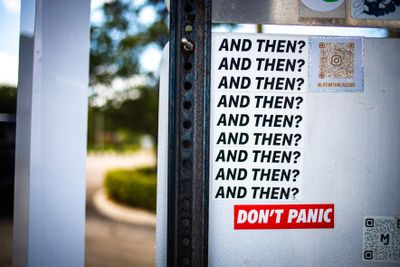
One thing that stayed with me were the artifacts on the walls. Empty beach photos. Shitty banners. Hints vaporwave and mallsoft. The visual residue of a specific internet moment — call it 1997 to 2004 — embedded in the Backrooms' endless corridors like objects left by previous occupants who didn't explain where they were going. For anyone who was there when those things were made, they read as something more specific than retro texture. They're therapy notes found in a wall. Someone else's, and somehow also yours.
I built websites that looked like that. I worked in offices full of that aesthetic, met the people inventing the infrastructure those images lived on. I even got a Covid vaccine in an abandoned department store that felt exactly like that — fountain on, nobody home. The uncanny for me wasn't the empty corridors. It was the evidence of prior habitation.
The corridors are empty for a reason. These are spaces that once carried things — not just people but informal knowledge, the kind that doesn't get written down: how to navigate an institution, read a room, inherit a set of working assumptions about how things are done. That transmission broke somewhere between the people who built those spaces and the generation that grew up after them. The Backrooms aestheticizes the gap. This isn't new territory — Gone Home and Kentucky Route Zero were doing it in the mid-2010s, navigable then, watchable now. The direction of travel is toward less agency, not more, via a walking-sim-as-film this time. The horror, if you're young enough to feel it, may be less about what's lurking around the corner than the persistent sense of having arrived somewhere after everyone left without leaving instructions.
For a twenty-five-year-old encountering this natively, those artifacts probably land as generic period texture, the visual equivalent of a lo-fi playlist. That's not a criticism of the film or its audience — it's a description of what happens when cultural material stops being transmitted and starts being aestheticized. For the right viewer, in an unanchored state of mind, it probably lands. For anyone who was present when those spaces were live, it's closer to finding your own early resume in someone else's horror film.
Less a film, more of a mood. Which is maybe what it was always going to be. The original image — a single photograph of an empty office, posted to 4chan in 2019 — wasn't trying to tell a story. It was trying to make you feel that you'd been somewhere you couldn't quite place, or evoke a sense of dislocation and lost memory you never actually had. The film scales that feeling to cinema and calls it a narrative. It isn't, quite.
Go see it with someone half your age and compare notes after. In retrospect, maybe BACKROOMS is more boundary object than mood — more interesting for the dynamics it surfaces than the atmosphere it delivers.



Member discussion