Murder Walls and Case Files
Divergence and convergence in the sensemaking process.

I've noted recently, in the context of a workshop in Malmö, that I'm a devoted consumer of procedural crime drama — the Scandinavian kind especially, where the investigation is as much about institutional failure as individual wrongdoing. I have several shelves of the written kind in our dining room — running from early classics to more recent fare. I'm a sucker for any new show of this genre that drops on Netflix from some cold production climate. While not exactly in the regional genre, I'm also notorious among friends for my many, many rewatches of Fincher's Zodiac. OK, he also directed the less good remake of TGWTDT. But I digress.
The attraction isn't just atmospheric. My brain enjoys inductive sensemaking off the clock the same way it does on: accumulating fragments that don't yet mean anything, waiting for pattern to emerge from noise, reconstructing cause from a surface full of effects. It's the same cognitive appetite as my day job, just without the deadline. It also explains my other hobby, structuring elaborate thrillers I will someday find the time to fully write (at least three currently parked in iAWriter, if you're counting).
Which is probably why, when I needed a quick way to describe the process arc behind a forecasting project we've been building — the movement from associative early research through to a finished, communicable output — I reached instinctively for two objects from that genre: the murder wall and the case file. Invoking them as structural metaphor seemed to help the forecasting team imagine the jump from messy Miro board to an assembled set of numbered forecasts more clearly, as well as the relationship between them.
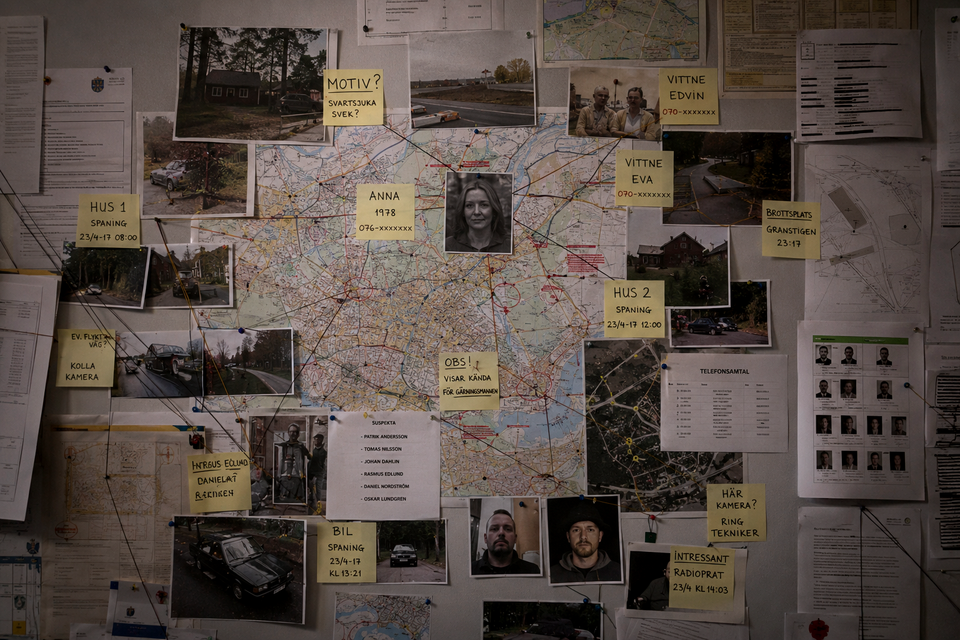
The murder wall, which some call a crazy wall or murder map, is inductive thinking made physical. Proximity signals relationship. Contradiction gets preserved rather than resolved, because resolving it too early closes off what might still be the most important thread. The gaps are as legible as the connections, sometimes more so. Nobody builds a murder wall to present conclusions — they build it to find them, and the finding isn't just a matter of collecting signals and naming the clusters.
The real work is around causal relationships: not just what's appearing but why it's appearing now, what pressures produced it, what conditions made this signal possible rather than some other one. The pattern is a symptom. What generated it is the point.
The wall also serves a social function that's easy to overlook. In film and TV, the wall often lives in the common space of the investigation team because it's a shared thinking object — the place where the team reasons together, where the supervising detective performs the reconstruction out loud, where the argument gets tested and revised before it hardens into anything. Edwin Hutchins would recognise it as a cognitive artifact the team thinks with collectively, not just thinks about — cognition distributed across people, space, and the physical arrangement of evidence (in actual law enforcement the string board has a formal equivalent, the Anacapa chart).
The case file, however, is a different object entirely. It's organized not for discovery or collective reasoning but for transmission — chronological, structured, the argument already formed and the edits already absorbed into the presentation. It looks complete in a way the wall never did and never pretended to be. It's the deck.
But here's what the genre makes clear that's easy to miss: you can't charge someone from a wall. You have to charge them from a file. The reasoning has to be cleaned up, the contradictions resolved, the causal chain made legible to someone who wasn't in the room. The lossiness isn't a failure of translation — it's the function.
The project that prompted this reflection ran the arc described above deliberately, moving from a scanning and synthesis phase with the logic of the wall — holding contradictory signals in tension, following threads before knowing where they lead, reasoning collectively before concluding individually — through to outputs with the logic of the file, arranged for a reader who wasn't there when the string went up. Both objects are necessary. Neither substitutes for the other. Most of my projects have some form of these artifacts in some shape – the map for me, the file for everyone else.
What stays with me is the distance between these forms — not as a problem, but as the space where the thinking happens and then becomes invisible. The file doesn't show its wall, and probably shouldn't try. But understanding that the lossiness is structural, even necessary, doesn't make it feel like less of a loss. Clients may never see what's lost. Most don't want to know. Decision-making doesn't tolerate ambiguity, and rarely wants to know what caused the pattern — only what to do about it.
Now, off to sit in the Spanish springtime sun, with the British Police MIRSAP guide in my lap.
Writer Lauren Beukes built one of the better documented examples of this — a wall dense with photographs, index cards, and color-coded string tracking three separate timelines, while writing The Shining Girls. We've recently rewatched the Apple TV+ adaptation, which was even better the second run through. Her wall existed to produce the novel and then, as all working walls do, came down. The book and show, thankfully, remained.
Subscribe to receive by email, get occasional audio posts, and more.


Member discussion